

For a Minneapolis business, electricity is one of the few major operating costs that feels completely out of your control. Rates rise, demand charges fluctuate, and the bill arrives every month whether business is up or down. Commercial solar is one of the few moves that turns that unpredictable cost into something you own and can plan around. If your building has roof space or land sitting unused, it is worth understanding what solar can actually do for the business.
This is not a sustainability pitch. The case for commercial solar in Minneapolis is a financial one, and it rests on a few specific things: how commercial electricity is priced, the tax treatment available to businesses, and the long-term value of locking in a predictable energy cost. Here is what to weigh before you invest.

It Is About Operating Costs, Not Just Sustainability
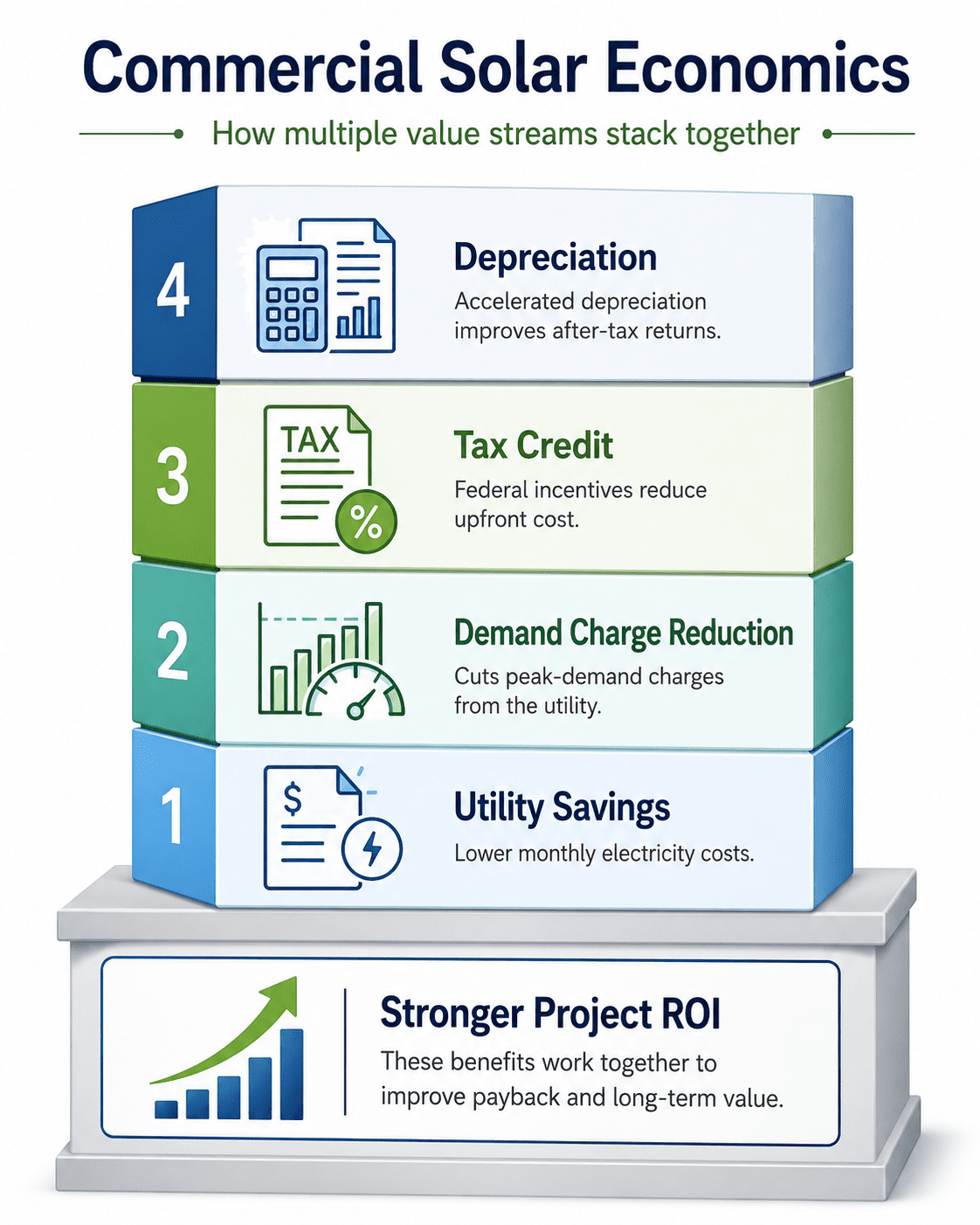
The biggest difference between a home electric bill and a commercial one is the demand charge. Many Minneapolis businesses are billed not only for how much electricity they use, but for their highest spike in usage during the month. Those demand charges can make up a large slice of a commercial bill, and they are exactly the kind of cost solar, especially when paired with storage, can help reduce.
On top of that, commercial solar gives a business something rare: a predictable energy cost for decades. When you generate a meaningful portion of your own power, you are insulated from the steady climb in utility rates that every American business has watched over the past several years. For a company trying to forecast operating costs three and five years out, that predictability has real value on its own, separate from any incentive.
The Incentive Picture Right Now
This is where commercial solar diverges sharply from residential, and where the timing genuinely matters. The federal tax credit that homeowners used ended at the close of 2025. The commercial credit is on a different and more favorable clock.
Businesses can still claim a 30 percent federal Investment Tax Credit on a qualifying commercial solar project, but the window to lock it in is closing. Under current federal law, a project generally needs to begin construction by July 4, 2026 to secure full credit, with the system placed in service within the following few years. Projects that start after that face tighter deadlines. On top of the credit, businesses can use accelerated depreciation on the system, and the combination of the two means many companies recover a substantial share of the total project cost, often approaching half, through tax benefits alone. For nonprofits, schools, churches, and other tax-exempt organizations, a direct payment provision lets them capture the equivalent of the credit as a cash payment, which historically they could not do at all.
These rules are specific, and time sensitive, and they are exactly the kind of thing where a consultative conversation beats anything you might read in an article. Our Minnesota energy incentives and financing page is a starting point, and a specialist can tell you what applies to your specific building and timeline. The important takeaway is that the most generous version of the federal benefit is available for a limited window, so a business seriously considering solar has a real reason to evaluate it now rather than later.
What Actually Affects Your Payback
No two commercial projects pencil out the same way, and the honest answer to “what’s the payback” is that it depends on your building and your usage. A few factors drive it more than others. Your usage profile matters, especially how much power you draw during daytime hours when solar is producing, since a business that runs hardest from nine to five is a near perfect match for solar generation. Your demand charges matter, because the more of your bill they represent, the more there is to offset. Your roof or land matters, both the available space and its condition. And your tax situation matters, since the credit and depreciation only help a business with the tax appetite to use them. There are a number of factors to consider but once you have the data the benefits of solar become clear.
This is why a commercial evaluation starts with your actual energy bills and building, not a generic quote. The same principle drives our residential advice in starting with your energy needs first, and it matters even more at commercial scale where the numbers are larger.
Roof and Building Considerations in Minneapolis
Minneapolis has a lot of building stock that suits solar well. Warehouses, light industrial buildings, retail centers, and offices often have large flat roofs that are close to ideal for a commercial array. A few local realities are worth planning around. Flat commercial roofs use ballasted or attached racking systems that have to account for Minnesota snow load and wind. The age and condition of the roof membrane matters, because you want the roof to have plenty of life left before you put an array on it, the same coordination issue some homeowners face with removal and reset. And local permitting and Xcel interconnection for a commercial system is more involved than a typical home installation, which is one more argument for a contractor who works in this market regularly.
Solar, Storage, and Demand Management Together
For many Minneapolis businesses, the strongest setup is not solar alone. Pairing solar with battery storage lets a business actively shave expensive demand by discharging stored power when necessary, and it adds resilience for operations that cannot afford downtime. Layering in energy management to understand and control when and how the building uses power turns the whole system into an operating cost reduction strategy rather than just a green initiative. A comprehensive, system approach is where commercial solar delivers the most value, and it is worth designing it correctly from the start.
How to Start
The first step is not a quote, it is a look at your actual energy usage and your building. That tells you whether the numbers work, what size system makes sense, and how the current incentive window applies to your timeline. Given that the most generous federal benefit is time limited, a business that is even considering solar this year benefits from running that analysis sooner rather than later.
Powerfully Green Solar helps businesses and homeowners across the Minneapolis–St. Paul area take control of their energy use through smarter systems, not just solar alone. If you want to know whether commercial solar makes sense for your Minneapolis business and how the current incentive window affects your timeline, request a commercial assessment or talk to a specialist who knows Xcel’s commercial rates and the Minneapolis market.