
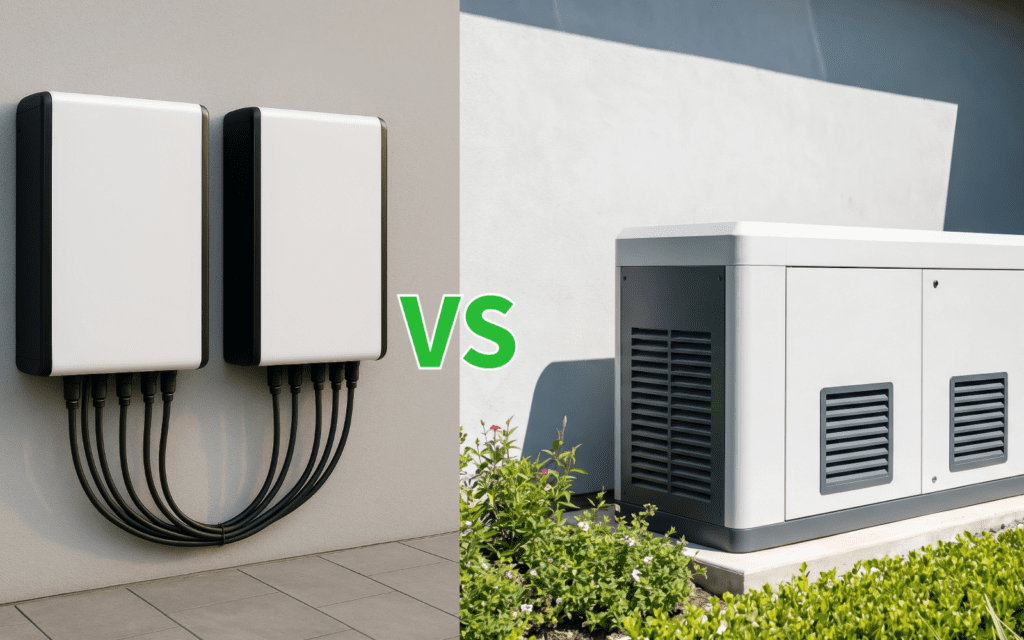
Both generators and home batteries solve the same basic problem: keeping your home functional when the grid goes down. But they solve it in very different ways, with very different tradeoffs. And for a Minnesota home, where outage risks look different in January than in July, the comparison is worth thinking through carefully rather than defaulting to whatever your neighbor installed.
This is not a post that declares a winner. The right answer depends on your home, your heating system, your outage history, and what you’re trying to accomplish beyond backup power. But by the end of this, you should have a clear enough picture to know which direction fits your situation.
What a Generator Actually Does
A standby generator, the kind that’s permanently installed outside the home and wired into the electrical system, runs on natural gas or propane. When the power goes out, it starts automatically within about 30 seconds and runs the house until the grid comes back on. As long as fuel supply is maintained, runtime is effectively unlimited.
That’s a genuinely significant capability, especially for Minnesota winters. A natural gas standby generator doesn’t care how long the outage lasts or what season it is. It runs.
Portable generators work on the same basic principle but require manual setup, use gasoline, and are not wired into the home’s electrical system. They power what you plug directly into them. For the purposes of this comparison, we’re focused on permanently installed standby generators, which are the more direct comparison to a battery backup system.
The practical downsides of a standby generator are real:
Running a generator produces noise and exhaust. It’s not a system you forget is running. Neighbors notice. Smaller outages, the kind that resolve in two or four hours, involve the full startup sequence, the engine running, and then the shutdown. That experience is different from a battery, which operates silently.
Generators require ongoing maintenance regardless of whether they’re used. Oil changes, regular test runs, annual inspections. A generator that sits unused for a year and then fails to start during a real outage is a failure mode that happens. Maintenance prevents it, but maintenance has a cost in both time and money.
A whole home standby generator in Minnesota typically costs between $8,000 and $15,000 installed, depending on size and the complexity of the gas line connection. That number is in the same neighborhood as a battery backup system.
What a Backup Home Battery Actually Does
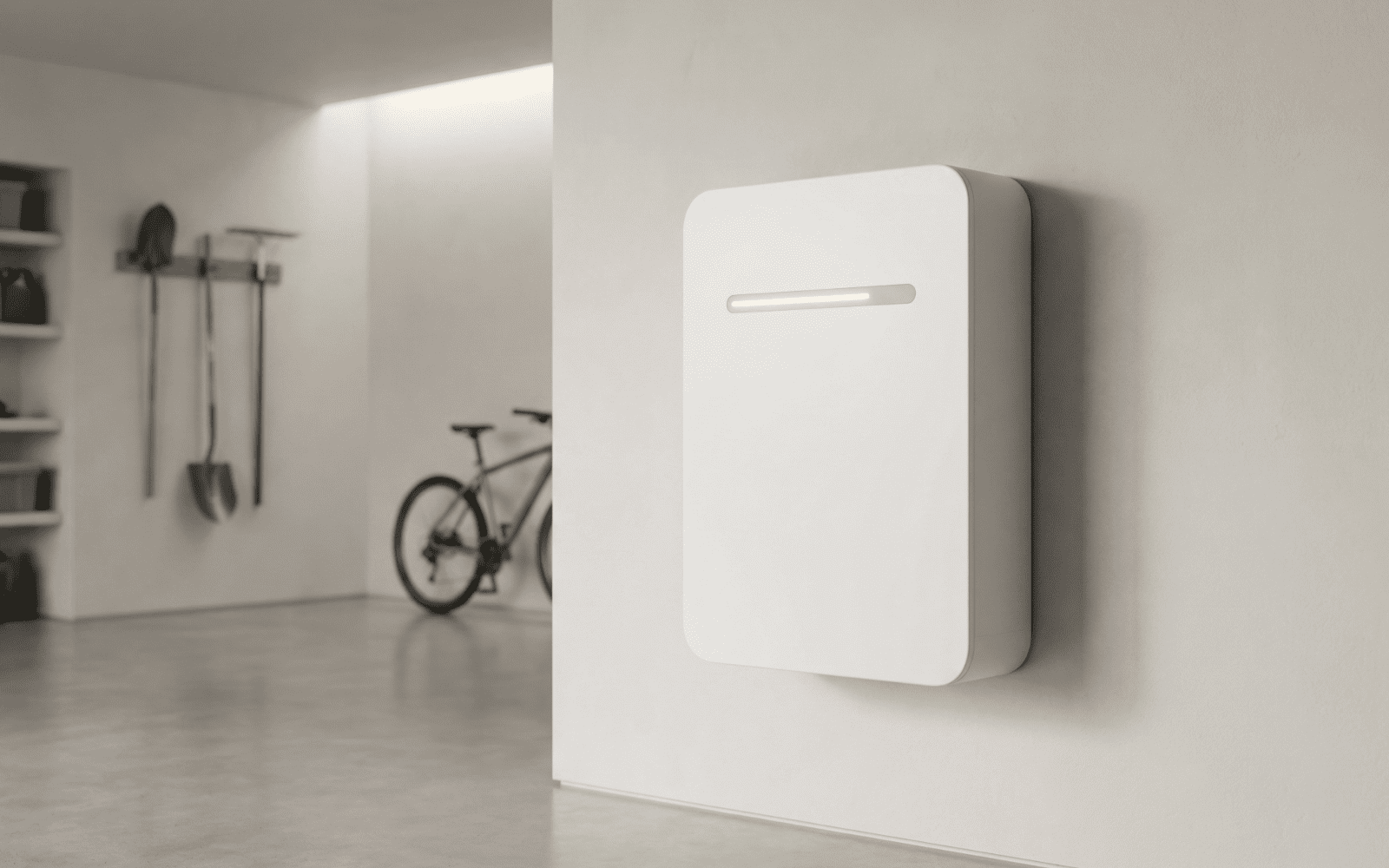
A home battery stores electricity from either the grid or a solar system and discharges it when needed. Unlike a generator, it has no moving parts, no exhaust, no noise, and no ongoing maintenance requirements beyond the system monitoring that happens automatically.
During an outage, a properly configured battery system switches the home to battery power in milliseconds. There’s no 30-second startup window, no engine noise. It’s seamless.
The constraint is energy capacity. A 13.5 kWh battery, the most common single-unit size, carries a finite amount of energy. How long that lasts depends on what’s drawing from it. For a gas heated home running essential loads, that’s typically 12 to 18 hours. For a heat pump in January, it’s much shorter.
A battery paired with solar changes the equation meaningfully. Solar recharging during the day can extend battery coverage through multi-day outages in favorable conditions, effectively giving the system a renewable fuel source. That’s something a generator cannot offer.
The Minnesota Winter Test
This is where the comparison gets most interesting for homes in the Twin Cities and surrounding area.
A standby generator’s advantage is most obvious in January. It runs indefinitely on natural gas, so it can power a heat pump, an electric furnace, or whatever heating system the home has, within reason. For a family that heats with electricity and wants absolute confidence in a deep winter outage, a generator’s unlimited runtime is a real advantage.
A home battery’s advantage is most obvious in shorter outages, in moderate seasons, and when it’s paired with solar. A spring storm that knocks power out for 18 hours is an ideal scenario for a battery. The system seamlessly covers the home overnight, the solar system recharges the battery the next morning, and the homeowner experienced, similar to a generator, mostly a normal life.
The battery’s weakness in a Minnesota winter scenario is capacity. A heat pump drawing 4,000 watts through a cold night can exhaust a single 13.5 kWh battery in three hours. Two batteries extend that to six hours. Three batteries get you through a full cold night. The question becomes whether you want to buy enough battery capacity to handle a worst-case January outage, or whether a generator handles that scenario at lower cost.
For homeowners who heat with natural gas, this entire calculation shifts. A battery only needs to cover the furnace blower, the lights, the refrigerator, and the other essential loads, which together draw far less than an electric heating system. That’s a much more manageable scenario for a battery storage approach.

The Everyday Use Question
This is the dimension that tips the comparison most decisively in many cases.
A generator does exactly one thing: it provides backup power during outages. On every other day of the year, it sits idle. It earns its keep only when the grid fails, which for most Twin Cities homeowners happens somewhere between once and five times per year, for durations ranging from a few hours to occasionally a few days.
A home battery does something every single day. Paired with solar and under a Time-Of-Use electricity rate program, it stores energy during peak production hours and discharges it during the evening when rates are highest.
When not under a Time-Of-Use rate program it can charge from extra solar power generated during the day and be used at night when the sun goes down to help avoid utility rate energy costs. That daily utility is something a generator simply cannot offer.
In addition, conventional generators consist of many moving parts that can malfunction in various ways when left sitting idle or unused for months at a time. The risk here is that when you need it most it doesn’t function as planned. This possibility also exists with battery based back up systems but when you use the system as part of your daily energy routine you can be constantly ensured that its working, and will be available in the event of an emergency.
This is the core strategic difference. A generator is insurance, purchased and maintained against a scenario that may or may not arrive. A battery is both insurance and a daily financial tool, which changes the return on investment calculation significantly.
Installation, Incentives, and Total Cost
Installed costs for both options are roughly comparable in the current Minnesota market, with standby generators coming in at $8,000 to $15,000 and battery systems running $10,000 to $20,000 depending on capacity and configuration.
The financial picture diverges from there in two important ways.
First, home batteries can be eligible for special incentives, especially when paired with solar, depending on your utility or even your city. This can lower the initial cost.
Second, generators have ongoing costs that batteries don’t. Annual maintenance, occasional repairs, and fuel costs during extended outages add up over a 10 to 15 year system life. A battery system has minimal maintenance requirements once installed.
The financial case for a battery is meaningfully stronger than it was a few years ago. That’s worth factoring into the comparison beyond the sticker price.
Who Each Option Makes More Sense For
A standby generator makes more sense when:
- The home heats with a heat pump or electric resistance and you want unlimited winter outage coverage regardless of duration
- You’re in a rural area with a history of multi-day outages and no solar on the home
- You’re not interested in the daily energy management capabilities of a battery and just want the simplest backup solution
- You’ve had a specific bad experience with a long winter outage and want the maximum assurance of unlimited runtime
A home battery makes more sense when:
- Home battery can be used everyday to avoid utility based energy costs
- You’ve already installed solar and want to extend that clean energy investment and the potential savings associated with time-of-use utility programs
- You want a silent, seamless system that you genuinely don’t notice during an outage
- You’re interested in energy independence and reducing grid dependence over time, not just solving the outage problem
- You’re thinking about the whole energy picture for your home, not just backup as a standalone concern

The Honest Answer
For most gas-heated homes in the Minnesota Twin Cities suburbs, a home battery paired with solar is the stronger long term choice. It covers the most common outage scenarios, earns real financial returns every day, can qualify for meaningful incentives, and positions the home for broader energy independence as rates continue to rise.
For homes with electric heating that want absolute winter confidence, a generator’s unlimited runtime is a genuine advantage that’s hard to match without a large battery investment . In some of those cases, a hybrid approach, battery for daily use and a smaller, portable generator for peace of mind.
The worst outcome is buying a system sized for the scenario you imagined rather than the one you may actually have. That’s why the conversation starts by defining your specific need ( your home’s specific load profile, your outage history, and what you may want to protect in the event of an outage). Starting with needs rather than product offerings will result in a far stronger alignment with your ultimate strategy. Powerfully Green Solar helps homeowners across the Minneapolis–St. Paul area take control of their energy use through smarter home energy management systems and strategies. If you’re trying to figure out whether a battery, a generator, or a combination makes sense for your specific home, please give us a call or schedule a home energy assessment and get a recommendation grounded in your actual situation.